Tuesday, August 13, 2013

Marriage proposal made amidsts costal ocean waves

There's always some new imaginative ways of making marriage proposal memorable. This one related to ocean waves naturally caught my attention. Here's the start of the story:
On November 21st, 2012, Matthew Hartman attempted to pull off an epic marriage proposal that his girlfriend would talk about for the rest of their lives. He led her to a large rock surrounded by ocean waters at Laguna Beach, California, and then sang her a song that he wrote for the occasion. Then he got down on one knee to pop the question. Or, at least that was the plan.
A large ocean wave had other plans for the couple. At just the wrong time, it decided to crash the party and sweep the girl off her feet before Hartman could. . . . 
The article, written by Michael Zhang on March 10 this year, consisted a video and a series of picture recorded this memorable event, took place at Laguna Beach, California and planned by the future groom Matthew Hartman and his photographer friend Jonathan Hwang. Here's what had happened according to Hwang:
On the day of the event, I arrived just as his friends were laying down a path of candles out to the rock that Matt was planning to stand on. That idea was quickly swept away as an enormous wave engulfed both the candles and the friend who was laying them down. Having witnessed that scene, everyone began to panic and we almost decided to have the proposal on the beach instead of out on the rocks. I tried my best to reassure everybody, telling them, “What are the chances of it happening during the actual proposal?”
However, I was secretly hoping that the odds would be on my side and that they would get swallowed by a wave. After all, that was the shot I had dreamed about. Little did I know that I would get my chance right as the ring makes its first appearance. Looking back, it probably was not the wisest thing to put the two in potential danger, and thankfully nobody was hurt.
The last comment "nobody was hurt" is certainly the best and thankful part of the whole story.  No one can guarantee this but they just happened.  Hwang's concluding comment tells it all:
In the end, it might not have been the most thought out proposal, nor was it safe by any means, but the results from that day turned out to be both spectacular and breathtaking–literally!
So that's the way it was happened -- a nice story book like story. Hope their future life together will be just as happy and successful as this drama of making very special memorable marriage proposal turned out to be!


Tuesday, July 30, 2013

Sounding the alarm on renegade waves

This interesting article by the Chicago Tribune columnist Mary Schmich, published a week ago, just came to my attention.  The headline of the article "Sounding the alarm on renegade waves" attracted my attention first. No one as yet, as far as I know, has ever used the word "renegade" in connection with freaque waves before.  I was gratified to realize that she wasn't trying to introduce a new name!

Here's her article:
The rogue waves were coming.
Ten feet. Twelve feet. Higher.
It was all over the news. The rogue waves could soon be pounding into Chicago like a posse of bandits, a band of terrorists, the horsemen of the apocalypse.
An alert had been issued from 9 a.m. Tuesday through Wednesday morning.
Stay off the breakwalls. Stay out of the water.
Right.
The surest way to get Chicago people to the lakeshore, short of cheap beer and fireworks, is to promise them something as exciting as rogue waves, which is why I grabbed a sun hat Tuesday afternoon and headed to the beach.
Before I went, I did what any modern person does in anticipation of disaster. I consulted Google.
What exactly was a rogue wave anyway?
I'd seen big waves in Chicago. A few summers back, as I was biking, a huge swell of water crashed into the lakefront and a towering spray swept me off my bike and almost swallowed the bike whole.
But rogue waves? They sounded especially ominous.
"Rogue, freak, or killer waves have been part of marine folklore for centuries," said the website of the National Oceanic and Atmospheric Administration, "but have only been accepted as a real phenomenon by scientists over the past few decades."
Rogue waves, other sites reported, are also known as extreme waves, abnormal waves and monster waves.
Armed with that vast vocabulary, I went in search of terror.
The 31st Street beach on Chicago's South Side is one of the city's prettiest. The bike path is wide and smooth. The skyline rises in the near distance. In summer, the prairie grasses and wildflowers shimmer while the masts of white boats clang in the harbor. Most uplifting of all, parking is just a dollar an hour.
I cared about none of this. All I wanted were rogue waves.
There were, in fact, some waves, more than usual in the windy day, little white-topped swells that the kids splashed in.
But rogue? These waves were about as roguish as Justin Bieber.
While I waited for the rogue waves to arrive, I called Chicago's climate master for further enlightenment.
"I hope you haven't been misled into thinking you're going to see one," WGN's Tom Skilling said. "I'm a little surprised as much has been made of this as has."
He suspected that the description "rogue waves" was intended to push bikers, joggers and curiosity seekers off the shoreline and away from some dangerous big waves, though not necessarily rogue ones.
The rogue wave, he explained, isn't just a giant wave. It's a wave that is far bigger than all the waves around it.
Gulliver in the land of Lilliputians, if I understood correctly.
"The rogue wave is a freak," he said. "It's often the marriage, the intersection, of two waves that slam into each other. Rogue waves also form where you've got a wave intersecting a current flowing opposite it."
Such a wave, he went on, can happen in oceans or in lakes. There's a theory that a rogue wave caused the legendary 1975 sinking of the SS Edmund Fitzgerald in Lake Superior.
Rogue or not, the waves were definitely building in Lake Michigan on Tuesday, and Skilling noted that the winds — which result in waves — were also building, in a way unusual for July.
Dramatic weather, he explained, is often caused by the clash of cold Arctic air and the warmer air in the lower 48. But in summer, when Arctic regions warm up, such clashes of air are rare.
"This is not the time of year when you get highly organized winds," he said.
(I had a vision of highly organized winds arranging their spice drawers alphabetically. Or color-coding their perfectly folded underwear. But back to rogue waves.)
"It is interesting that we, even for a brief period, have winds that are as well-organized as they will be later today and into tonight," he said.
So, who knew? A rogue wave might turn up.
"If you see one," he said, "let me know!"
In the late afternoon, I drove north to the Foster Avenue beach, still chasing rogue waves. The waves were bigger there, verging on wild, though none of them was freakishly tall and alone.
Daredevils continued to bike and jog at the water's edge, but many people just stood and watched, struck still by the force and the mystery of the wind on the water.
Whatever you call it.
I am not quite certain if Ms. Schmich was disappointed that she did not really seen a real freaque wave, or she was just a little sarcastic, or may be a little bit of both.  Since she has already recognized that freaque wave can be "sounded especially ominous" and she did experienced first hand of being "swept off" her bike on the lakefront, I hope she's content with her experience and not really expect to see anything worse when she "went in search of terror".  Even though she sounded the alarm: "The rogue waves were coming" and they did not come.  That's really something good for us to just be happy, not worry!


Thursday, July 18, 2013

Two freaque wave encounters, two incrdeibly successful rescue, Thank God!

The Post and Courier of Charleston, SC just published an article entitled "There's nothing like a one-in-a-million survival of the sea story", authored by Dr. Edward M. Gilbreth, that tells two real cases of encountering with freaque waves and two incredible survival stories.  Here's the first one:

A few years ago I wrote a column about a local angling enthusiast, Reese Ward, who had a horrifying experience while on the way back to Charleston after fishing the Gulf Stream.
He had momentarily left his mates to go aft and answer Mother Nature’s demands. There he was, otherwise minding his own business, when an unexpected rogue wave suddenly pummeled the boat and sent Ward flying into space.
Rather than landing on deck, he sailed straight into the water and watched in disbelief as the boat motored onward and away.
He screamed at the top of his lungs, to no avail, and might as well have been in outer space. Long story short, after several hours of treading water and going through the extremes of emotion — from shock, fear, anger, determination and tearful resignation — what should finally appear on the horizon but that same vessel returning to conduct a miraculous rescue!
It was a one-in-a-million survival story, as palpably real to Ward now as it was then.

This first story serves as a lead to his main story as:

Well, here’s a story out of the Nantucket Inquirer and Mirror as told by senior reporter Jason Graziadei, in which a party of five had a similarly terrifying ordeal.
It was a cold, rainy morning this past May when boat captain Jason Mleczko set out from Madaket Harbor with four passengers. Mleczko, whose father, Tom, started the family’s charter business back in the 70’s and whose sister, Allison, is a well-known Winter Olympics hockey champion, had handled conditions far worse over his 17 years of chartering.
I know Jason and his dad. They’re fine people, understand what they’re doing and run a great business. As anyone who spends time on the water knows, the ocean can turn fickle, unpredictable and dangerous in a heartbeat.
Jason would be reminded of that all too vividly when, after several hours of fishing the west side of the island between Smith Point and nearby Tuckernuck Island, three large rogue waves came out of nowhere and flipped his 23-foot Maritime boat completely over.
Mleczko and one of the men were briefly trapped under the boat, but managed to swim out and climb on top of the upside-down hull. The three others were thrown far away and had to struggle to make it back to the boat, their bodies stung by water temperatures still in the 50s.
Mleczko knew the situation was very serious. Everyone was miserably cold; cellphones were either lost or waterlogged and unusable, the marine radio was nose down in the water, and only one life jacket could be found. There was no way to cry for help.
The captain tried to reassure passengers that his father knew where they were fishing and understood that they were supposed to be back in harbor by 3 p.m., and that the cavalry would be called no later than 4 p.m.
Meanwhile, a fog bank had started to roll in, and hypothermia was becoming real concern. Recalling a survival program he had seen on TV, Jason ordered a changing rotation used by wild penguins, in which individuals are sequentially huddled for a few minutes in order to get warm.
As minutes turned to hours, intense worry and concern started evolving into desperation, if not panic. Two of the men wanted to swim for it. Mleczko knew this would be a lethal decision — possibly for everybody. There’s no way the men could have survived the 1½-mile swim, and the risk of hypothermia would have only increased for the others left behind.
Cooler heads fortunately prevailed, and the group remained intact. Meanwhile, father Tom was worried but knew in the back of his mind that Jason was a highly experienced waterman. But by 4:30 p.m, he couldn’t take it anymore, and he set out initially on a personal search, thinking that it would take too long to mobilize the Coast Guard.
At approximately the same hour, his son came to the dire (but unspoken, of course) realization that, unless they were found by sundown, he and his party’s chance of survival would be slim.
As Tom Mleczko frantically trolled the waters off Smith Point, there was a brief and miraculous lifting of the fog, just long enough for him to notice the faint outline of something in the water, his eye caught by the desperate waving of the one orange life jacket still in the castaways’ possession.
It was then that Jason finally lost it.
“There was a moment I thought he didn’t see us, and it was despair. But then he turned,” Mleczko said. “That was the first time I cried. I broke down and wept. We were going home. It was awesome.”
In hindsight, the senior Mleczko wished he had called for help earlier. It was a terrible ordeal, “... really something, as a parent and a father. It was really an emotional thing.”
Jason has since been credited with displaying calm and sensible leadership throughout the crisis. In an email he said, “I have certainly learned from my experience and am a better captain because of it. ... I’m grateful to my passengers. ... They were truly remarkable and earned their rescue with their fight for survival.”

The author of the article, a Charleston physician (edwardgilbreth@ comcast.net),  masterfully tells these two incredible stories, I have no choice but to faithfully copy them all here. Both stories are real freaque wave encounters that are happening somewhere, sometime around the world oceans daily, not many can get duly reported in great detail as these two and in lively vivid description on what was really happened out there as:

. . . when an unexpected rogue wave suddenly pummeled the boat and sent Ward flying into space.
Rather than landing on deck, he sailed straight into the water and watched in disbelief as the boat motored onward and away.

and

. . . three large rogue waves came out of nowhere and flipped his 23-foot Maritime boat completely over.

We certainly wish all freaque wave encounters in the ocean can all be recorded so detailed and end up in one in a million chance successful rescue.  It is so gratifying to read happy ending stories like these two.  With the help of the Good Lord, we wish all the freaque waves encountering cases can always be happy ending ones. Deo Gratias!

Wednesday, July 10, 2013

A 50-foot freaque wave washed over the bow -- the real thing!

This is an entertainment news report, but there's nothing entertaining about it. It's the real freaque wave encounter story in Bearing Sea! As David Strege of KBTX tells it:
The Bering Sea can be a dangerous place, and for those who make a living fishing for crab, the threat of death looms large, particularly in stormy conditions. One occupational hazard is rogue waves. They hit without warning and so fast deckhands have no time to prepare.
Such was the case aboard the Saga while crab fishing at night. The scary incident was captured during filming of last Tuesday’s episode of Discovery Channel’s “Deadliest Catch.” A 50-foot rogue wave washed over the bow, covering the deck and sending one crab pot overboard, nearly taking a deckhand with it.
Captain Elliott Neese watched in horror from the safety of the bridge.
“Yeah, is everybody on the boat still,” Neese said over the loudspeaker in a panicked voice as he scanned the deck, searching out his deckhands. “Is everybody still there?”
Someone answered, “Is everybody all right? Uh, yeah.”
Deckhand Kevin Vanderpol was preparing one of the pots when the wave hit.
“I felt as if I was going into the pot,” he said. “I just threw my hands underneath the launcher. The pot slid out.”
What would have happened had the wave pushed him into the pot? Engineer Mike Vanderveldt said such an outcome would have meant instant death.
“If you’re in the pot and the pot goes overboard, you’re going to the bottom with it,” he said.
Once everybody was accounted for, Neese let out a sigh with a whistle and one word, “Wow.”
Now you know why they call it “Deadliest Catch.” This was definitely a close call, one that had Vanderveldt thinking about his occupation.
“This is going to make me hate crab fishing,” he said.
So this tells what was happening when a freaque wave hit.  But it does not help us understand what's happened with freaque wave any better! It just happened --  A 50-foot rogue wave washed over the bow, covering the deck and sending one crab pot overboard, nearly taking a deckhand with it.  It IS frightening! But for the people on board,  it's just another day at work on "Deadliest Catch."

What I would wish is that they could install some wave gage on board so we can revisit the episode via the wave recording.  That may still not helping us understand the waves better, but it's a good start!

Tuesday, July 09, 2013

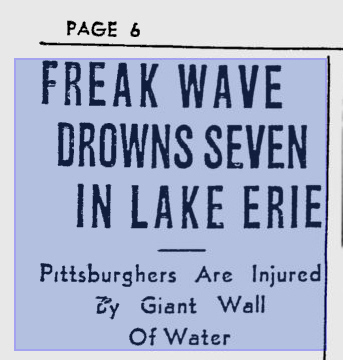
A forgotten 1942 Freaque wave/Meteotsunami case in Lake Erie

This is a rare find, from Google Search, a news on freaque waves of June 1, 1942!  It is here from The Pittsburg Press, published on "Monday, June 1, 1942"


in Page 6 with the headline:


It was reported by the United Press.  Of particular interest to note is that it was something already being called "Freak Wave" long before the term became academically popular decades later and it was also characterized by the now familar description -- "Giant wall of water"!   The essential of the report is this:
Cleveland, June 1 -- Scientists and weather observers agreed today that a sudden shift in wind was the probable cause of the giant wave which swept the Lake Erie shore line east and west of Cleveland early yesterday drawning at least seven persons and injuribng several more.
So the happening in Lake Erie near Cleveland, Ohio was on May 31, 1942 -- a case no one seemed to have remembered that it had happened.  When the famous Lake Michigan squal line case near Chicago happened in Junem26, 1954 with 8 fishermen drawned, there's clearly resembles to the Lake Erie case dozen years earlier, but no one ever made the connection.  They should all be the new topic of meteotsunami study.  But this one is a forgotten case!  Thanks to Google Search that by chance brought it to my attention. (Understandably 1942 was in the early stage of WWII, people clearly were less inclined to pay attention to some Lake Erie shore happenings, even with 7 lost souls.)  This was not the first case or another similiar meteotsunami case.  This one does provided some important information not alluded in other cases -- the sound effect!
One fisherman described the wave as an enormous black wall that blotted out everything and rushed in with a deep rolling rumble.  The only warning he said was a shrieking noise like a siren which preceeded the wave. (Emphasize added.)
I think not all similar cases will have this sound effect clearly noticed as this one here by the very observant fisherman in 1942.  But by all means sound effect shoud be also an element to be considered in the Freaque wave/Meteotsunami research!

Thursday, June 27, 2013

Pray for the missing US schooner in South Pacific


This is the AFP file picture of a schooner posted in the South China Morning Post to accompany the following distressing news:

Searchers said on Thursday they have grave concerns for seven people aboard an American schooner that has been missing for three weeks between New Zealand and Australia.
Maritime New Zealand said on Thursday that searches by plane this week found no sign of the 70-foot (21-metre) wooden vessel named Nina, which was built in 1928.
Authorities say there are three American women and three American men aged between 17 and 73 on board. Also aboard is a British man, aged 35.
The boat left the Bay of Islands in northern New Zealand on May 29. Authorities say the last communication was on June 4, when the Nina was about 370 nautical miles west of New Zealand.
Steve Rendle, a spokesman for the Rescue Coordination Centre New Zealand, said authorities were first alerted to a potential problem on June 14, when they were contacted by concerned family members of the crew.
A storm that day saw winds gusting up to 110 kilometres (68 miles) per hour and waves of up to 8 metres (26 feet).
“Quite often when yachts are sailing around, they have their own arrangements when it comes to keeping in contact,” he said.
He said the boat had an emergency locator beacon aboard but it had not been activated.
Rendle said authorities began a communications search on June 14, which involved attempting to contact the boat through various radio frequencies as well as contacting other boats in the same area.
He said a New Zealand Air Force plane on Tuesday conducted a search around the area where the boat went missing. A second search by the plane on Wednesday went as far as the Australian coast but again turned up nothing.
He said he didn’t have an exact timetable for the boat’s trip, but that authorities would have expected it to have arrived in Australia by this week.
So intense prayers are in order for the safety of the 7 people on board. May God's mercy and blessing to bring them safe sailing.


Meteotsunami hits New Jersey Barnegat Light


This story was published in the evening of The Morning Call of the "Lehigh Valley's First Source for News" of June 25, 2013 written by Peter Hall with the title of "Freak Jersey shore wave being called a tsunami."   The article reports a firsthand account of the tsunami-like wave from Brian Cohen, who was spear-fishing in the inlet when the wave hit.
Cohen said the tide going out through the inlet suddenly became stronger about 3:30 p.m., carrying divers over a submerged breakwater and eventually exposing rocks in the structure that are normally 3to 4 feet underwater. 
The strong current out to sea continued for one or two minutes, and Cohen backed his boat away from the breakwater to avoid being pulled over it, according to the tsunami warning center. 
Cohen then noticed a large wave 6 feet tall from trough to peak spanning the mouth of the inlet. The current reversed direction, causing a surge of sea water into the inlet that washed divers back over the breakwater.
One of the main consequence of the phenomenon is that reportedly there were three people who were walking on a breakwater south of the inlet, normally 5 or 6 feet above the ocean, were swept into the water. Two of them were injured badly enough to require medical treatment, according to the report of NOAA’s tsunami warning center.

The news is clearly posting wide interests as it has been widely reported around the country and beyond.  But it was up to the USA Today which published the report by Todd B. Bates and Kirk Moore of Asbury Park Press that appeared to set the news straight by first reporting with the correct terminology currently used in the academic world:  "Meteotsunami that hit Barnegat Light on June 13 knocked three off the inlet jetty, injuring at least two people" :
ASBURY PARK, N.J. -- It appears that a rare type of tsunami called a "meteotsunami" hit the New Jersey coast June 13, with Barnegat Light bearing the brunt of the wave.
"There was a strong weather system that moved from across the eastern U.S. that day, then moved offshore New Jersey," said Paul Whitmore, director of the West Coast/Alaska Tsunami Warning Center in Palmer, Alaska.
Strong weather systems can cause jumps in air pressure, spawning waves that act just like tsunamis, Whitmore said.
"The impacts were greatest there in Barnegat Light," he said. An approximately 6-foot wave knocked three people off the inlet jetty, injuring at least two of them, according to a center report.
So there you have it: a happening of meteotsunmai in New Jersey shore! 

Wednesday, June 26, 2013

Hero fisherman saves mate in epic swim

This happy ending story today is from Australia's Seven News:

A hero fisherman has saved the life of his injured mate after an epic three-hour swim through freezing waters off the Gold Coast.
A freak wave struck the men's dinghy as they returned from a fishing trip late on Tuesday afternoon, leaving one of them with two dislocated shoulders and a dislocated hip.
They had just enough time to grab their lifejackets before the boat went under.
In a heroic act of endurance, the injured man's mate hauled him across two kilometres of freezing open ocean, battling strong currents and big waves.
Three hours later the pair came to ashore on South Stradbroke Island, but were still in danger as they hadn't set off their distress beacon and had no shelter as temperatures plunged into the single digits.
The men were able to gather branches, which they used to make a crude shelter while they awaited rescue.
Relatives of the men contacted police on Tuesday night when the men failed to return from the trip and the search area was narrowed, based on where the men usually fished.
At one point, the freezing men could see a search helicopter on a beach on the island, but they weren't able to signal the crew.
Sergeant Tony Nelson said the pair knew the chopper would be back and resigned themselves to wait in the cold.
"Once the boat capsized, they were able to adapt quite quickly," he told reporters.
"They were always confident that they would make it to the shore. I think they were fortunate."
The men are both in a stable condition in hospital.
The man who towed his mate to shore is being treated for hypothermia.  
And this man is most certainly the hero!  The Seven News article has an appropriate headline: "Hero fisherman saves mate in epic swim." 

Tuesday, June 25, 2013

Miracle at sea in Atlantic near Nigeria

This news, a few days old, from gCaptain by Joe Brock, just came to my attention:
WARRI, Nigeria, June 12 (Reuters) – After two days trapped in freezing cold water and breathing from an air bubble in an upturned tugboat under the ocean, Harrison Okene was sure he was going to die. Then a torch light pierced the darkness.
Ship’s cook Okene, 29, was on board the Jascon-4 tugboat when it capsized on May 26 due to heavy Atlantic ocean swells around 30 km (20 miles) off the coast of Nigeria, while stabilising an oil tanker filling up at a Chevron platform.
Of the 12 people on board, divers recovered 10 dead bodies while a remaining crew member has not been found.
It is an incredible story! Here's the punchline of the survival story:
Somehow Okene survived, breathing inside a four foot high bubble of air as it shrunk in the waters slowly rising from the ceiling of the tiny toilet and adjoining bedroom where he sought refuge, until two South African divers eventually rescued him.
with some further details:
At 4:50 a.m. on May 26, Okene says he was in the toilet when he realised the tugboat was beginning to turn over. As water rushed in and the Jascon-4 flipped, he forced open the metal door.
“As I was coming out of the toilet it was pitch black so we were trying to link our way out to the water tidal (exit hatch),” Okene told Reuters in his home town of Warri, a city in Nigeria’s oil-producing Niger Delta.
“Three guys were in front of me and suddenly water rushed in full force. I saw the first one, the second one, the third one just washed away. I knew these guys were dead.”
What he didn’t know was that he would spend the next two and a half days trapped under the sea praying he would be found.
Turning away from his only exit, Okene was swept along a narrow passageway by surging water into another toilet, this time adjoining a ship’s officers cabin, as the overturned boat crashed onto the ocean floor. To his amazement he was still breathing.
Read the whole article, it's fascinating!  And here's another gCaptain report by Bob Almeida entitled "Miracle at sea . . .":
As reported earlier this week, tragedy struck offshore Escravos, Nigeria on Sunday 26 May when theanchor handling tug Jacson 4 sankin heavy weather.  Divers recovered 10 bodies from the sunken ship and 1 is still missing.
Miraculously however, the ship’s cook, Mr. Okene Harrison, was found alive after spending roughly two days inside the sunken vessel at a depth of 30 meters.
Now how does one to expect a miracle to survive in a disaster?

Monday, June 24, 2013

Tribute for a fallen surfer at Goldcoast Burleigh


Here's a nice coast nearshore area picture published by the Goldcoast.com.au this morning:


It's the picture of a surf zone complete with surf waves with surfers gathered that seems they are having an enjoyable time.  The picture has this caption:   "Dozens of surfers paddle out to remember Matt Hughes, who died in a freak surf accident at Byron Bay recently."  The title of the article is: "Tribute for fallen surfer."  And now the story:
DOZENS of surfers paddled out to Matt Hughes' favourite break at Burleigh on the weekend to pay tribute to the father-of-three, who died in a freak surfing accident at Byron Bay.
Family members held hands and formed a small circle inside the ring of surfers during the emotional tribute on Saturday, scattering rose petals in the waves he loved so much.
Mr Hughes was killed when his longboard hit him on the head, bursting a vital blood vessel, on June 9 at Byron Bay's The Pass.
The 39-year-old's brother Anthony Hughes said his family was overwhelmed by the support, with about 500 people attending the paddle-out.
``It went as good as we could have hoped for,'' he said.
``It was uplifting but I'm still riding the roller-coaster at the moment.
``It was a beautiful show of just how much he was loved in the community. It was huge.
``To be honest, it really does show the sort of guy he was. He was just a likeable, easy-going guy.''
Matt's wife, Michelle, who saw the accident unfold, said she took comfort in the fact that her husband's organs were used to save the lives of at least five people.
It is a rather bitter sweet story.  The tragedy was not caused by freaque wave but it was a  " freak surf accident " unfortunately.   No accident is expected or can be predicted. This one is especially seemingly should not have happened. But it did and  it's heart warming to see the surfers are out there paying tribute to the tragic fallen surfer. We sincerely pray for Mr. Matt Hughes, R.I.P. and hope this kind of freak accident will never ever happen again.

Sunday, June 23, 2013

Super full moon

According to this news item:

“A supermoon is when the moon will come to its closest point in its orbit around the earth for the entire year,” says Derrick Pitts, chief astronomer at the Franklin Institute. 
The moon will appear 14 percent larger than normal as it swings closer to Earth than usual.
It was supposed to be cloudy last night and it was.  But around 10:30 pm the cloud opened up somewhat and the moon brightly appeared and I was able to captured the supermoon of 2013 successfully!


I guess moon always holding plenty of romantic notions for human mind ever since ancient times, even after the Apollo lunar mission and Astronaut Neil Armstrong landed the mankind's giant leap on the moon, we still like to keep some of the mystics from our childhood fancy.  Somehow for me, looking at that bright super moon last night, for a brief moment, remembering those long faded childhood dreams, I feel young again!


P.S.

This World of Science Facebook page here has the super full moon image from all around the world.  Enjoy!


Wednesday, June 12, 2013

Ocean waves seen from outer space

I have been advocating making spatial realistic ocean wave measurements, but at what scale?  Here are two fascinating views from current astronauts Karen Nyberg and Luca Pamitano on the International Space Station Expedition 36/37.  The pictures were presented separately on Twitter recently:

The following picture is from Astronaut Karen Nyberg: The Maldives


Now these are the real spatial ocean wave pictures as seen from the outer space we have never seen before.  What do we know about them? Any freaque waves in there?  Most importantly why would anyone can still settle for 70 year old single-point wave measurements?

Sunday, June 09, 2013

Atlantic Ocean Road in Norway

When I first saw this picture in World of Science, my immediate thought was how are the waves along the road side of this Atlantic Ocean Road in Norway?


Well, the answer is here and in this video:


Curiosity can always be fulfilled on the internet!  Exciting wave watching there! Sincere thanks to all for sharing!

Saturday, June 08, 2013

Fishos flipped overboard!

The title of this report in ntnews.com.au is "Fishos flipped overboard." Fisho, according to Wiktionary is an Australian slang for fisherman. Here's the story written by Ellie Turner:

THREE brave fishos swam almost a kilometre to the shore of a remote Territory island - in croc-infested waters - after a freak swell swamped their 4.5m tinnie.Public servant Aaron Packham, 38, said the sea was calm when he and his wife, Dannielle , and their mate Brett dropped anchor in their well-equipped boat at Bynoe Harbour yesterday.
"It got a bit choppy, so we headed closer to shore - then two or three decent waves jumped in the boat,'' Mr Packham said.
"There was nothing that we could do.
"Another one came over and just drenched the boat, and it went completely down.
"I tied the EPIRB around my neck and started swimming.''
They had travelled about 60km from Crab Claw Island on the second day of a fishing weekend when trouble struck.
The trio used Eskies and a fuel tank as floaties.
Brett was picked up by a crew of fishermen who took him to Crab Claw, southwest of Darwin, to raise the alarm and get more help.
But the boat was too small to take all of them.
Mr Packham set off the emergency beacon when he and his wife climbed ashore on Indian Island at 11am.
The Careflight turbo-prop King Air plane, en route from Darwin to Katherine, was diverted to search the popular fishing harbour.
It showed a Navy helicopter where the couple, who suffered some scratches, were stranded.
A Careflight chopper picked them up and the team later drove them back to Bynoe to pick up their car.
"The boat's upside down somewhere bashing against rocks,'' Mr Packham said.
He said they were all thankful to the emergency crews and the other fishos who helped during the rescue.
"We had all the right gear but that's just the way of nature,'' Mr Packham said.
"We're lucky to be alive.''
The last sentence is certainly a welcome punch line for the story. To that we can only add "Amen." All it took was "two or three decent waves jumped in the boat" and then "another one came over" that did it! A fishing trip ended unfortunately with their boat "upside down somewhere bashing against rocks."  Well, whatever happen, happened. Let's just be happy and thank God for the fact that they are alive and well. Deo Gratias!

Friday, May 31, 2013

Skim Boarder Makes a Miracle Save.


Here's a heart warming story about life saving in Aliso Beach published in Laguna Beach News. As shown in the above picture, the hero, Pat Watch on the left, holding a baby he just rescued.  According to the report by Andrea Adelson:


Quick action by a skim boarder saved the life of an infant pulled into a rip tide by a rogue wave on Saturday at Aliso Beach, according to witnesses.

Pat Watson, 46, who took up skim boarding after moving from Hawaii in 1991, said he threw his board aside and took off in a dead sprint when he saw a child tumbling down the sand berm into swirling whitewater. “I couldn’t see anyone else moving,” said Watson, who was skimming with his son, Danny, 18. They both “bolted” for the child.

“I was on it,” Watson said. He figures he covered 75 yards before diving into the surf, even though he had yet to see the child resurface. Incredibly, Watson caught sight of her underwater and grabbed her diaper. “I knew she’d been under water at least 15 seconds,” said Watson, who held the baby up overhead while still trying to get his footing before another wave overtook them.
When he resurfaced again, holding the child like a football to his chest, Watson said she wasn’t moving. “I flipped her over,” he said, flooded with relief when she began to cough, vomit up seawater and cry. He placed the child in the outstretched arms of the trembling, unidentified mother, who left the beach before speaking to authorities, Watson said.
“It’s a phenomenal rescue,” said Jason Young, chief of OC Lifeguards, responsible for guarding Aliso, one of the county’s most popular beaches. “Once a human submerges, there’s a very low chance of saving them,” Young said.
At the time of the rescue prior to noon, county guards were not yet scheduled for duty in Aliso’s towers, Young said, though one guard in a vehicle was roving between Aliso and Three Arch Bay beaches. Laguna’s five southern beach coves are county beaches.

It is always gratifying to read a story like this one.  The editor gave the article a nice headline: "Skim Boarder Makes a Miracle Save."  And the article concludes with this aftermath:
Later, Watson’s daughter told him she had observed the incident’s origin, seeing a rogue wave sweep the beach and swamp the mother, wearing street clothes and walking near the top of the sand berm, who twice attempted to grab the child before she tumbled into the surf.

Other than skimmers, few people were in the water because of the strong surf, Watson said.
So it all started with a freaque wave sweep the beach. It was a local happening, but great rescue story nevertheless -- and for believers it's a miracle indeed there are God's fingerprints all over it!

Monday, May 27, 2013

Happened at Shoal Bay Beach


This nice beach picture is a picture of Shoal Bay Beach northeast of Australia's Newcastle, New South Wales. The picture accompanies an article published this morning in the Border Mail, written by Alison Branley, entitled "Wave surge kills tourist":   

A strong wave surge has been blamed for killing a 60-year-old woman while she was walking along Shoal Bay Beach in Port Stephens at the weekend.
The woman, understood to be from Londonderry in Sydney's west, was reportedly walking along the west end of the beach when she was knocked unconscious by a shore-dumping wave.
It is believed the tourist was dragged out by the wave and drowned.
Paramedics were sent about 8.30am on Saturday after the woman was pulled unconscious from the surf.
They tried to revive the woman but she died at the scene.
Reports suggest the woman may have lost her shoe and had been trying to retrieve it when she was struck.
Despite sleepy Shoal Bay's reputation for calm waters, the spot at the west end of the beach is known among locals as a notorious spot during wave surges because of a combination of steep sand and shore dumpers.
So here, again, a sad beach tragedy happened! Even in a beach that has a reputation for "calm waters"! Well, as the locals know the dangerous of the spot is notorious, how can a tourist be so informed and be forewarned not to lost her shoe there?  It all seems so unreal, but tragedy always happens when there is least expectation!  May the lady rest in peace and may all tourists have a heightened sense of caution so that not to let their guard down when enjoy walking on those beautiful peaceful beaches!

Wednesday, May 01, 2013

Life's ebb and flow

U. Southern Cal.'s USC News yesterday yesterday published this article, written by Marc Ballon, entitled "Life's ebb and flow" that tells a rather sad, freakish happening but emerged as an inspirational and uplifting story of their Engineering Ph.D. student, Ryan Williams:

Ryan Williams led a charmed, sun-splashed existence.
The USC Viterbi School of Engineering PhD student found his classes stimulating, professors engaging and research on autonomous underwater robots fascinating. And then there was his California Dreamin’ lifestyle.
Williams, a native of Roanoke, Va., luxuriated in the Southern California sunshine, golfing, swimming and skiing. He even took up surfing, which energized him.
“The California mentality was refreshing and, of course, the weather was amazing,” he said.
And then everything changed. On Jan. 27, 2008, Williams went to Santa Monica with friends to catch some waves. As he paddled toward the breakers, he dove under an oncoming swell.
In a freak accident, he landed headfirst in a hidden sandbar and snapped his neck. He lost all feeling in his legs and arms. If not for the two surfers who pulled him from the water, Williams would have surely drowned.
At just 26, the former high school pitcher and star basketball player had become a quadriplegic, with no use of his legs and limited use of his hands. Many people in a similar position would have understandably retreated into self-pity and bitterness. Not Williams.
“I don’t feel downtrodden at all,” he said. “I try to say, ‘this is life. This is the way it is. Let’s try to do something with it.’ ”
He's certainly determined to "do something with it" with a roaring start! That's really showing a remarkable and courageous young scholar with a brilliant future.  We wish all the best for him. Go for it!

Thursday, April 25, 2013

Dark soliton?

About two weeks ago, United-Academics magazine published the following story about "Dark Solitons" that entitled "Dark Solitons Demonstrated For the First Time":

In physics and math there are wave structures called solitons (notsolutions) that are defined as self-contained packets or pulses.  Two types of solitons that have long been of interest in the world of scientific research are bright and dark solitons.  Until recently, only bright solitons have been successfully demonstrated in a wave tank.  This month a team of researchers at Imperial College London, including mathematician Amin Chabchoub, successfully created an example of a dark soliton in water.  Their actions bring important new information that will impact the world of optics, oceanography, and beyond. 
In the context of the ocean, waves evolve in that familiar manner as they as ebb and flow. Solitons, on the other hand, somehow manage to keep a constant size and shape.  They also travel more slowly than regular waves. In the 60′s and 70′s oceanographers observed bright solitons in the deep sea, later successfully recreating them in a laboratory setting.  Their work revealed that bright solitons are the cause of, among other phenomena, rogue waves that occur at sea. It was then theorized that dark solitons must be capable of the opposite- decreasing the power of a wave. 
Using a 17 meter long wave tank, Dr. Chabchoub and his team simulated wave formations as they passed through dark solitons.  What they found was that, indeed, there was a reduction in the amplitude of the waves.  With this result the team now wants to investigate what happens when bright and dark solitons come together. Their hope is that if they continue down this current path, this information could help coastal regions better deal with large waves caused by extreme weather or earthquakes.  Today’s dark soliton experiments in a laboratory could become tomorrow’s anti-tsunami safety system.

Their source was this article in Physics World with this impressive figure that called "dark dip".

Illustration of a dark soliton

I think the key sentence that may get everyone excited is this one:
Their actions bring important new information that will impact the world of optics, oceanography, and beyond.
I guess oceanographers and ocean wave scientists would be interested. But, but, BUT, I just failed to see there's any real ocean wave connection here that can be translated the theory to the real ocean, especially deep-trough kind of freaque waves in the ocean are not uncommon. Obviously theoreticians do need this ocean implication to justify their far out theoretical mumbo-jumble could have some sort of real world usefulness, but what, where, and how it can be done are still the unanswerable questions every time a new theory came around to make this conjecture and this one this time is certainly no exception.  There is as yet just no conceivable road way to link between theoretical ivory tower and the real ocean -- an unavoidable fact that no theoretical gurus would care to face!!