Saturday, April 09, 2011

Not easy to be a rescuer

It is certainly not easy to be a rescuer as this New Zealand case reported by Kate Saunders in Taraanaki News:
A rogue wave flipped two rescuers as they tried to help a kite surfer off Waitara yesterday.

The Waitara Surf Lifesaving IRB was launched just before 4pm after three kite surfers got into trouble when winds changed off the outer reef.

Acting Senior Sergeant Royston Betteridge said police were called by a member of the public and by the time they arrived two of the men had made it back to shore.

"The third man was in the water for quite some time, but when the IRB went out to get him it got into difficulty and flipped, which caused it to lose power."

Because of the low tide and conditions, other boats could not be sent out, he said.

"They had all their safety gear on, so they were in no real danger. It was unfortunate that they went to help and they ended up having engine problems."

The crew flipped the vessel back over and swam it back into shore – ironically with the help of the third kite surfer, who they had been sent to pick up.

After starting on the New Plymouth side of the sand bar, they washed up 200 metres along the beach, on the Urenui side.

Mr Betteridge said the kite surfers had been caught off guard by a changing offshore wind. It is believed one of the men lost about $2000 worth of kite surfing gear.
We know this is happened in shallower water nearshore during low tide, as usual there is no further information than just calling it a rogue wave. But luckily this case ends with everybodybeing safe and sound, a happy ending. Thanks be to God!

By the way, according to Wikipedia, Waitara is the name of a town and a river in the northern part of the Taranaki Region of the North Island of New Zealand.

Friday, April 08, 2011

An ultimate extreme surf spot list


SurfToday.com just published an interesting article headlined with this intriguing picture. The article provided a list of carefully picked "ultimate extreme surf spot" that included a video of actual local waves for each spot. It is not only useful for the surfers but also for wave watchers and wave aficionados who are simply fascinated by the waves in general. The article calls the waves shown on the video "insane wave" that certainly makes the list and videos a valuable source of enjoyment for wave watcher like me. Now the question in my mind is in what role can science play in these "insane wave" processes? Oh well, just enjoy them will be sufficient for now!

This week!

This past week I have been in Vienna, Austria attending the EGU2011 where my friends Prof Alex Babanin started a successful new Wind Waves session this year, and Prof. Efim Pelinovsky organized yearly Extreme Sea Waves session is again in full blooming. This afternoon there was a very active poster paper session, all the old and new friends were there mingling and enjoying the final intellectual swing. It was my good fortune to have the opportunity meeting two brilliant young Russian scientists, both are Pelinovsky’s students. To my exceeding surprise that they both admitted reading my blog, yes this blog, and kindly encouraged me to continue doing it. Thank you so very much, Ira and Irina. I have been doing this blog for my own information and amusement as a personal blog. I really had never expected that there are actually people out there interested in reading this blog at all. Now I have to brag about it, you made my day!

Monday, April 04, 2011

Hokusai in politics!


I guess it is inevitable that sooner or later wave will be used in political cartoons sometime. But this Hokusai is a good one, it's not political, it's common sense! Why couldn't the politicians so generous with other people's hard earned money recognize it? Thumb up to Mr. Michael Ramirez.

Sunday, April 03, 2011

Happened at Blackpool seaside


Here's another depressing case just happened at Blackpool seaside and reported in metro.co.uk:
A man has died after being hit by a freak wave in Blackpool, despite desperate search and rescue attempt.

The victim was standing on steps near the resort's Cocker Square, close to the water's edge, when he was swept away in front of shocked onlookers.

Officials said a huge rescue mission was launched with coastguard officers from Blackpool and Lytham St Annes joined by a helicopter from RAF Valley and Blackpool RNLI inshore lifeboats.

The man, aged 44, was eventually recovered from the water and taken ashore to a waiting ambulance.

However, he was confirmed dead at Blackpool Victoria Hospital.

Su Daintith, Watch Manager at Liverpool Maritime Rescue Co-ordination Centre, said: 'The man, we believe, was about to enter the water at the bottom of the seawall steps when he was swept off without any warning by a large wave which was a result of the overnight weather conditions

'Our thoughts are with his family and friends during this tragic time'
This case is depressing because it is so unreal. The man was ready for the water, how can he lost his life this way? Ah! that's the freaque part of the freaque wave. "He was swept off without any warning by a large wave" as the news report indicated. No one knows what really happened yet. This is not an unheard-of case. A possible scenario is that the victim might have hit his head when he was being swept off unexpectedly. We'll never know the force and how extensive the force might impose. Many tragic cases had happened similarly over the years all around the world. We don't know how to predict it and we don't know how to prevent it. It is depressing just to think about it!

For those of us who's not familiar with the area, Blackpool, as shown by the picture at the beginning of this post, is a seaside town in northwest England, 30 miles (48 km) north of Liverpool, and 40 miles (64 km) northwest of Manchester according to Wikipedia.


Thursday, March 31, 2011

What about waves?

New Scientist magazine posted this article "Wind and wave energies are not renewable after all" yesterday. (Registration required.) But reading the article it turns out that all it talked about was wind. What about waves?

Here is the paper that was just submitted with a long title "How does the earth system generate and maintain thermodynamic disequilibrium and what does it imply for the future of the planet" by Axel Kleidon. Is this using long title to make you breathless just reading it a new tactic in the new world science?

Sunday, March 20, 2011

The loss of a Big-Wave surfer

Tragedy is hard to blog. Not being a surfer or a follower of surfing, I have never pay attention to different surfers. So the name Sion Milosky never made an impression on me. When I first heard of he lost his life while surfing in California, it was a tragedy, but did not feel strongly about blogging it without knowing about the details of the wave. Well, I just came across this report from Mercury News, I guess it describes the wave condition that Mr. Milosky encountered which is about as good as one might expected:

As the giant wave swelled at Mavericks, Sion Milosky paddled into it. He'd caught more than a few when suddenly the lip of a wave he was riding collapsed on top of him. Milosky went down, and the wave crashed over him -- again and again.

After surfing what some called "the session of a lifetime," Milosky, a 35-year-old Hawaiian known as one of the best big-wave riders in the world, died late Wednesday.

And this one:

Fifty-foot waves do not discriminate -- especially those that lurch from the deep open ocean at Mavericks, the region's iconic surf break near Half Moon Bay. From world champion surfers such as Kelly Slater to underground daredevils like Sion Milosky, the waves' raw, violent energy places the life of any mere mortal in the balance.

On Wednesday, Mavericks claimed Milosky, a respected 35-year-old Hawaiian with a wife and two daughters back home on Oahu's north shore. Milosky was a welder by trade but forged his truest identity as a fearless charger in the midst of four- and five-story waves, often at remote outer island reefs in Hawaii.

That told what had happened. It was an accident, a tragic accident. It's always sad to hear it. Now hundreds of news articles have written about the tragedy. This SFGate short tribute entitled "Surfer Sion Milosky's death atMavericks underscores ocean's force, attraction" is a good one completes with a video monologue. I would like to just show the following short video showing Sion Milosky in action in his memory:

Saturday, March 12, 2011

Devastating Japan earthquake and Tsunami

Tsunami is not freaque wave because it is generally expectable, but it can be much more devastating. Yesterday's staggering 9.0 Richter scale earthquake in northeast Japan killed over 1300 people and sent catastrophic 33 foot tsunami hurtling across Pacific Ocean according to this DailyMail report.

Here's an AP picture showing the vortex of a whirlpool formed by tsunami waves at a port in Oarai, in the state of Ibaraki. Note that there is a small fishing boat caught in the mid of the whirlpool.

And here is the model output of the case:


Now here's the NOAA issued graphic of Tsunami wave heights as it travelled across the Pacific basin.
Our prayers are with all the devastated good people there, may God help them rebuilt their life in earnest blessing and for those lives lost may they all be rest in peace.

Thursday, March 10, 2011

A story from email exchanges

While cleaning and sorting out my old emails I came upon a set of emails that re-reading them still give me some personal thrill and satisfaction. That was a few month before I retire from my active duty in April 2007, I received this email:
Dear Mr. Liu,

I am a 5th Grade student at Glenelg Country School in Howard County, Maryland. I am doing my 5th Grade Science project on rogue waves. I have read several articles that you have published on this topic of rogue waves. From what I've read I can tell that you are an expert on these freak waves. I was hoping that you would be willing to answer some questions.

My first question is: What is the biggest rogue wave that you know of?

My second question is: Do rogue waves have to occur as a result of an extreme storm or can they occur in calm waters? After a lot of reading on this subject, I am not quite sure I understand if rogue waves must be born of a storm. I know that another type of wave, a tsunami wave, is usually a result of an underground earthquake.

Thank you for your time.

Yours very truly,
G Cadoux
5th Grade

Duty bound, I duly responded with pleasure. Here’s my response:

Dear G Cadoux,

I am thrilled to have received your email and knowing that a 5th Grader would be interested in freaque waves. All power to the Howard County school system.

Regarding your first question, I don't have a ready answer for you. I think you can find an answer easily through, for instance, Google search. The size of waves is not that important. When things go wrong, disastrous damages do not necessarily be caused by very large waves.

Your second question, however, is a very good one. Freaque waves can happen during storm *and* during calm conditions. At the present we do not know what was really causing the occurrence of freaque waves. There are a number of speculations that can lead to freaque wave generation one way or the other. But only speculations. When a freaque wave happen unexpectedly, which can happen any time at any place out there, with or without people around to see it, any number of speculations on their occurrence may or may not be applicable. You are correctly pointing out that Tsunami is caused by earthquakes, which is totally different from freaque waves. Although many adult media types still frequently mixed them up in their reporting.

I am not certain if I have answered your questions. If not, please feel
free to ask me again.

Cheers,

Paul C. Liu

She had a fellow up:

Dear Mr. Liu,

I am thrilled that you answered my questions about freaquewaves. You have answered my questions very fondly and the answers are very important, and also very interesting.

I do have one more question, this question is not on my report but I think it is important. I was on the internet watching a video about a fishing boat on DEADLIEST CATCH DiscoveryChannel, and this man left his video camera on and a rouge wave hit his boat. The rogue wave that hit his boat was as tall as a five storey
building. Have you ever recorded a rogue wave bigger in any way?

Thank you for helping me with my research and it has helped me a lot and sounds very interesting.

Sincerely,
Gabbe Cadoux

And I responded with this

Dear Gabbe,

The freaque wave case you saw on the TV show "Deadliest Catch" is obviously true. Waves higher than that one are known to have happened. Not being a sea-going sailor myself, I have not personally seen or experienced any. Waves can do damage not necessarily by its size. Sometimes a few meters high wave can cause disaster at the wrong place and the wrong time. The research on freaque waves is a young field, no one has any substantive answers yet. Mostly speculative. We don't know where or when it will happen or why. We only know that it will happen somewhere, sometime, somehow!

Regards,

Paul C. Liu

That was the end of my communication with Gabbe. But a couple of month later I received this:

Dear Mr. Liu,

My husband and I would like to personally thank you for responding to our daughter's questions about rogue waves. We are not sure how she came to select this topic for her science report but it proved to be very interesting. Your name frequently appeared in her research so we encouraged her to contact you. You are obviously an international expert on this topic. The fact that you took the time to address her questions was such an encouragement. Thank you again!!

By the way, she received an A++ on the paper. Her science teacher found the subject matter fascinating.

Regards,

Cathleen Cadoux

Now here’s my reply:

Dear Mr. and Mrs. Cadoux,

Thank you very much for your email. I am delighted to hear that Gabbe received A++ for her paper on rogue waves. Please extend my heartfelt congratulations to her.

There are plenty of activities in a research scientist’s life that’s routine and predictable. But communication with a 5th grader on a science topic is definitely not among them. I was truly thrilled to encounter a 5th grader who’s interested in rogue waves. And she asked very thoughtful questions. It was an enchanting experience for me.

Regards,

Paul C. Liu

Gabbe should be in high school by now. I am certain she'll be happy and successful where ever or whatever she chooses to pursue. All the sincere best wishes to her continued success. Life's happiness and satisfaction sometimes simply come from just doing one's job and be ones own self!

Monday, March 07, 2011

Wave power energy anyone?

This news this morning about a new wave power buoy by U.K.'s Birmingham Post.net is unlikely to be picked up by mainstream news reporters:

At 135ft long and weighing 250 tonnes the PB150 PowerBuoy device, created by Ocean Power Technologies (OPT), has a peak-rated power output of 150kW – equivalent to the energy consumption of approximately 150 homes.

Here's a picture of an OPT PowerBuoy, probably an early version, that was deployed at the Marine Corps Base Hawaii (MCBH) at Kaneohe Bay, Oahu according this well prepared article in San Clemente Times entitled "A New Wave" by Andrea Swayne a few days ago.

Swayne's article provided well researched reasons why wave power development has encountered so much resistence in general:
Most agree that new, renewable, green sources of energy are a good thing and those living near the coast are well acquainted with the potential energy of ocean waves and currents. Producing electricity by harnessing wave power seems like a no-brainer. After all, hydro-electricity from rivers and dams has long been a viable source of renewable energy. But some fear that taking this technology to the ocean could have potentially devastating effects on the fishing industry by making coastal waters off-limits as well as pose hazards to the environment by endangering sea life.
And:
Anglers are not the only groups concerned about a lack of communication to stakeholders and what this could mean for our coastline.

Environmentalist groups like the Sierra Club and the Surfrider Foundation also have concerns related to the proposed wave farm with regard to possible harmful effects on sea life—mainly potential harm to sharks and marine mammals caused by electrical fields.
One can not fault the concerns of these special interest groups. But these are just some of the reasons why it always seems that the U.S. is totally uninterested in wave power technology in the first place.

Recently a professor from Spain who started working on wave energy with their new Spanish government funding asked me what project has U.S. been working on. I can only told him that the U.S. does not seem to be interested in wave energy. Next time when I see him again, I'll be able to explain to him the reason why!


Saturday, March 05, 2011

A lucky beacch wedding

This lucky couple's wedding on the beach video has become instant hit on the Youtube. That's not necessarily their original intention. But it did. Along with their popularity are naturally all the goodwill wishes from total strangers for their long and happy life together!

Now for the freaque wave watchers, pay attention around the 2:40 time mark:


They characterized their beach wedding as "unlucky" and a news article even called it "disastrous' but I think they are in fact really very lucky, it's all happened manageably, no major mishaps. Especially when they went back to the beach for the pictures two days later on a nice day and encountered that freaque wave and both of them being swept on the beach. They are very lucky because that's all that had happened. Plenty of unlucky stories also happened that way. I saw a good numbers of Youtube beach weddings had took place, some even involved children. I guess Coast Guards are duly notified and be ready for anything that might happen. I sincerely appreciate Kathleen and Bryan chose to share their experience with us strangers. All the best wishes and lifelong happiness to them. I certainly would not advise any of my love ones to do something like that no matter how adventurous and well prepared they are at any circumstances.

Wednesday, March 02, 2011

Jeremy's story

This blog is about freaque waves -- which is generally keeping an eye on the science and the news about freaque waves. Only occasionally that I get comments here and there. Freaque waves, being unexpected and certainly unwelcome, encounter with it usually resulted in sad human tragedies with infrequent happy endings. In my last post there's a comment left by Mrs. Ruth Earnshaw of Alaska recounting the lost of their son Jeremy in Australia two years ago:

Never thought of freak waves until Father's Day 2008 when we received a call in Alaska that our son Jeremy had an accident. He was working with Youth With a Mission in Australia and he was at the beach that day showing his friends where he wanted to propose. The boys went down to walk on the rocks when a freak wave washed them in...our son Jeremy was never found.
She referred me to a website called onetwentyone.com for details. I actually blogged here two years ago about Jeremy's case shortly after it happened when Jeremy was still considered as missing and the search was still ongoing. Here's my comments made at the time:
The same familiar plot again: walking along coastal rocks when a freak wave washed them away!

The Australian police had already told the parents to “prepare ourselves for the inevitable, that he probably is not alive”. Let our best wishes and prayers be with the parents, miracle can happen and hope it can happen to this family.

Walking along a beach or coastal area is the most enjoyable thing and it can be peaceful and tranquil. Why can't we make it stays that way? We can explore Mars and go to the Moon, but no one cares to do something to make our beach and coast safer for human life. Why?
My misgivings are still the same: no one in the academia and the governments seem to really concerned enough on providing resources to learn more about the happenings even when tragedies happen so frequently. I wish to thank Mrs. Earnshaw for reminding us this tragic case. I was intrigued by the website called "onetwentyone". It is in fact an important part of Jeremy's story:
Jeremy had made numerous trips to Australia since 2003, working with the youth and studying at the Newcastle Youth With a Mission base. As part of his training, Jeremy participated in a mission excursion, working in orphanages in Cairo, Egypt. Before he left for Cairo, Jeremy decided to put a tattoo on his chest of Philippians 1:21, "For me to live is Christ, to die is to gain.”
I am sure that Jeremy is in a much better place now and he'll be continuously pray for us!

Sunday, February 27, 2011

Light on a lonely rock


I came across an interesting article from the Economist magazine two years ago: "Light on a lonely rock", talked about the Fastnet Lighthouse on Ireland's south-west tip at the mouth of the Atlantic and calls it "a monument of man's gift to mankind." The above's two pictures of the lighthouse. This article gives a brief history of lighthouse building that started 261 BC with Ptolemy I's building of the Pharos of Alexandria that stands over 400 feet tall with an open bonfire that could be seen 29 nautical miles away. At 177 feet high, the Fastnet light can be seen easily over 22 miles away.

What interests me is the comment by a former keeper that in stormy winter weather, the “big seas would come sailing up over the entire building like the field of horses in the Grand National.” In particular, Dick O’Driscoll, a keeper who spent 14 years on the rock, remembers a storm in 1985
"when a wave reached as high as the light and came crashing through the glass, overturning the vat of mercury and sending the poisonous liquid pouring down the stairs. He doubts the tower would have withstood another wallop as great as that, but it never came."
That could be considered as a freaque wave at different circumstances. This one only stayed in the keeper's memory and did not go into any records simply because it did not cause any damage -- so it's like that falling tree in the forest that did not make a sound!


P.S.

Speak of Pharos of Alexandria, the following is a Youtube segment from History Channel's recounting. What I found it's remarkable and somewhat disheartening is that it stood only for about 1500 years and now it's not there anymore. Nothing is forever!


Thursday, February 24, 2011

Tragedy on Aegean Angel


The above is a nice picture of the Oil Tanker Aegean Angel I found in vesseltracker.com which is the same shown in the Maritime Executive magazine that was credited to Arcadia Shipmanagement Co. Ltd . The tanker encountered an unexpected wave at the end of last year and resulted in two lost lives. Somehow the news did not gets around, it has only came to my attention recently. Here's what reported on January 31, 2011 by the editor of the Triton Nautical News:

On Dec. 30, the master and a chief engineer onboard the Greek-owned tanker, M/V Aegean Angel, were killed after a wave hit the ship in the mid-Atlantic, according to a story in Maritime Executive magazine.

The ship was sailing from Tallinn, Estonia, to Houston, Texas, with a cargo of fuel oil when it encountered rough weather northeast of Bermuda. The wave instantly killed the ship’s 47-year-old master and 33-year-old chief engineer and left the 34-year-old chief officer seriously injured, the magazine reported.

On Jan. 2, the chief officer was transported by U.S. Coast Guard helicopter to King Edward’s Memorial Hospital in Bermuda, where his condition was reported as stable. Ship manager Arcadia Shipmanagement Co. reported that the incident occurred when the officers were inspecting the deck for damage following rough weather.

There was no damage to the ship.

So it was just a wave hit the ship. But in another sounding about the case in Royal Gazette, Edward Harris described it as
"a 'freak wave' hit the supertanker Aegean Angel on December 30, 2010, killing two members of the crew".
I guess no one would really argue the terminology to say it's not a freaque wave that caused the tragedy. Unless, of course, when it is involved in the legal hassle then the distinctions may become critical such as what had happened in the case of SS Prestige in 2002.

Saturday, February 12, 2011

An impressive simulation of freaque waves in the ocean

Here's a very impressive theoretical simulation of freaque waves in the deep ocean I have ever seen:


This is from a Tulane University article entitled "Rogue Waves in the Forecast" by Mary Ann Travis. The article introduced the work of Tulane Physics professor Lev Kaplan that was presented at a colloquium. The voice in the video is presumably that of Prof. Kaplan.

This is impressive because it is a very realistic simulation of a small area of the ocean. And the occurrence of the freaque waves is readily demonstrated and undeniably believable. Though the real ocean may even be more complicated since there are still winds, wave breaking, and wave propagation effects not included in the simulation. While different people may derive different reactions to this simulation, I am being confronted with the nagging thought of how do we making realistic measurements to verify this theoretical result? Clearly this simulation at least renders the conventional wave measurements with 20 minutes recording at a single point totally ineffective if not useless. The freaque wave or waves came out of nowhere, lasted about 5 - 10 seconds and then everything returns to calm again. That's what has been reported to have happening out there. Now it has been theoretically substantiated. I think we are entering a brand new era of ocean wave research -- dealing with the real ocean, so that the wave research that still rely on single point wave measurements with 20 minutes recording for verification should clearly be deemed antiquated. At the gateway of the starting of the second decade of the 21st century, I can only say "It's about time!"

Friday, February 11, 2011

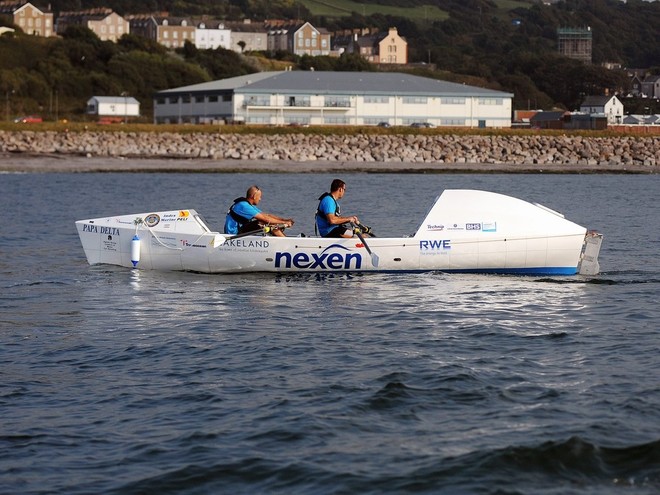
When "White whisper" meets "Papa Delta"

Out in the middle of the vast Atlantic Ocean, many things are happening. Sail-World.com just reported a heart warming story that will make every one happy to hear:
Call it serendipity or synchronicity, sometimes things happen for a reason. When the yacht White Whisper found their steerage had collapsed in the middle of the Atlantic Ocean, they thought they should let someone know they were disabled but continuing under a jury rig to their destination of Antigua. As they radioed Falmouth Coastguard, however, they didn't know they would soon be the life - savers.
Also in the middle of the vast Atlantic, 800 miles from the Canary Island, two rowers, brothers Chris and Matthew Cleghorn, who were crossing the Atlantic to raise money for research in Parkinson's disease, were hit by a freak wave. The boat recovered, but they found they had lost most of the food to the salt water drenching, and did not have enough to reach Antigua, where they were headed.
Their plight was conveyed to the world by Tom Cleghorn, their father, who became suspicious following email and telephone conversations. 'I had a funny feeling that something was wrong. When I found out they were rationing their food I decided we needed to do something about it.' He contacted Falmouth Coastguard.
With Falmouth Coastguard coordinating, the two long range incidents came together, to provide a successful conclusion for one of them, with the supply of food to the rowers on ‘Papa Delta’ from the crew of the yacht ‘White Whisper’.

Ian Guy, Watch Manager, Falmouth Maritime Rescue Coordination Centre, says: 'The yacht was several hundred miles behind the rowers but was following roughly the same track. As the yacht was going faster than the rowers we requested that they may be able to assist the rowers, by supplying them with food. At 9pm this evening (Tuesday) the yacht successfully met up with the rowers and passed them enough food to complete their trip.

'We continue to monitor the progress of the two vessels who are now both heading for Antigua.'

Everyone loves a Happy Ending.
Indeed! Everything happens for a reason. Can it be all just by chance?

Happy rescue at Cook Islands

Cook Islands are small islands in the South Pacific Oceancountry that has a self-governing parliamentary democracy in free association with New Zealand. Here is a happy rescue and survival story happened at Cook Islands after an encounter with freaque wave as reported by RNZI (Radio New Zealand International):

Posted at 17:57 on 10 February, 2011 UTC

A Cook Islands man is thankful he and his two fishing mates are alive after he made an epic six hour swim to help rescue his friends.

Te Ina Tapurau says the three men were several kilometres west of Rarotonga when a huge freak wave caused their small fishing boat to capsize in the early hours of Tuesday morning.

The tour guide says the men were unable to right their vessel and when one of his companions tired, he was determined to make it to shore to raise the alarm

“So we just decided to swim together, swim back. But my two other buddies, one was tired to carry on now, so I decided ohh, I’ll swim all the way for a rescue. I was just picking lights and I started drifting but I didn’t care where I was at least I make it on land.”

Mr Tapurau says the men didn’t have lifejackets on board and he swam supported by an empty petrol container, while his friends used a second container and a boat buoy to stay afloat.

His companions, Constable Johnny George and Augustine Heatherwere were rescued after twelve hours of drifting at sea.

News Content © Radio New Zealand International
PO Box 123, Wellington, New Zealand

A nice happy ending indeed, Deo Gratias!

Wednesday, February 09, 2011

Happened at Eugene, Oregon


This sad news is a very upsetting one to read, because the simple and repeating story line is so over-familiar. According to 14WFIE.com:
EUGENE, OR (CNN) - An Oregon community is mourning the loss of two teenagers who drowned after a wave pulled them into the water.
Jack Harnsongkram, 17, and Connor Ausland, 18, were playing with friends along the Oregon coast when the wave knocked them down on Saturday.

Coast Guard officials said the freezing water, sharp rocks and fast moving waves made for especially dangerous conditions.

The pair's friends saw what happened, but before they were able to help, the two had disappeared underwater.

"There's four of us who were there at the time tried our best to get them out," said Charles Larson, a senior South Eugene High School. "There was just - none of that was happening."

Perhaps the headline of oregonline.com described it very clearly: "Lives of two promising Eugene teens wiped out as sneaker wave leaves sadness in its wake" with these:

Flowers scattered on a dark outcropping of rocks on Monday marked the place where two South Eugene High School students, Connor Ausland, 18, and Jack Harnsongkram, 17, were swept to their deaths Saturday afternoon by a wave they never expected.

Yes, it was a wave they never expected but they should always expecting it! Here's a good Editorial in the Registered Guard:

It’s necessary at such moments to offer a reminder of the Pacific Ocean’s tremendous power. The waves, seemingly so rhythmic as to be predictable, can reach an unexpected and violent crescendo. People die every year on Oregon’s coastal rocks and jetties, and every year there are warnings that visitors should never turn their backs on the ocean. People should stay away from driftwood that is within reach of the surf. They should bear in mind that the next wave can wash much higher than the one before. They should be doubly wary when the tide is rising. All sound advice, too often ignored.

Yet there’s no sign that Harnsongkram and Ausland were doing anything particularly risky, beyond being in a place where a degree of risk is inherent. The world is full of such places — a mountain summit, a city crosswalk, a rocky shore. Certainly no blame attaches to the two young men. At most, they were victims of their own exuberance and vitality, which nourish the usually healthy urge to look around that corner, to see what’s over there, to go a bit farther, to explore.

Indeed, no blame attaches anywhere. The force of nature that killed Ausland and Harnsongkram is not evil, or even hostile; it is indifferent. The ocean is terrible, it is wonderful, and neither quality is intrinsic to the ocean itself — those are human judgments. If these drownings are part of some divine plan, the plan is unknown and unknowable, to be revealed only in a world beyond this one. Here and now, people are left with the hard fact that bad things sometimes happen for no good reason.

That just about sums up real well. The equally sad thing is that out of all the governmental and academical research efforts, none has ever really addressed to understand and prevent these hazardous nearshore-onshore happenings. We certainly can not blame any of them for staying within their comfort zone under the funding crumbs -- since they can not be stretched to be connected to the sexy man-made climate change studies. So for tourists and beachcombers they have to accept the fact of life that they might encounter a freaque wave any time and in a moment they can be disappeared underwater! We don't know when, we don't know where, we don't know why, and we don't know how, but the sad news just keeping repeating all around the world.

Friday, February 04, 2011

Life travels the world like a wave?

I was intrigued by the title and sub-title of this article: "A human life travels the world like a wave: Philosopher looked at impermanence", by Geoff Olson in Wednesday's Vancouver Courier. I can not quite fathom immediately what the article was really about.

He started the article rather poetically:

"Within a few hours of hearing the news, I was sitting by a creek, watching the waters churn past boulders."

We, as reader, naturally are interested in what the news he was hearing, but the answer is not forthcoming -- not until the very end of the article. The author next quotes Greek philosopher Heraclitus:“No man ever steps in the same river twice, for it’s not the same river and he’s not the same man,” which we can all agree with the impermanence in general . He then alluded to Walter Munk's 1957 finding, without mentioning Munk by name, that swells "reaching Guadalupe Island, off the west coast of Mexico, had originated in storms 9,000 miles away in the Indian Ocean." And "Even the 30-metre 'rogue waves' capable of turning over passenger ships eventually lose their fearsome appearance and attenuate into mere ripples . . ." the second part is clearly his speculation since no one really knows how freaque waves disperse yet. But now we get a sense that he is probably talking about life.

Now he return to the news:

Just before I got the news, I was halfway through an intriguing little book, The Wave Watcher’s Companion, by the marvellously monikered Gavin Pretor-Pinney. He reminds readers that waves travel through water molecules, which are jostled about but are left behind as the energy moves on."

The human body is comparable to a wave, he writes: “Apparently, once you reach old age, your body can contain none of the molecules it did when you were a newborn. As you grow by incorporating what you consume, every ingredient of your infant body can eventually be replaced: all the particular oxygen, carbon, hydrogen, and nitrogen atoms, and the other elements that were your nascent body, will have been replaced. You might say that we borrow the air, water and food we consume in the very way that an ocean wave borrows the water it passes through.”

Our sense of solidity is illusory. From a distant perspective a human body is like a wave travelling across through years of groceries and beverages. And on closer inspection the human body-mind is the sum of periodic rhythms, from the heart’s beat to the brain’s electromagnetic cycles. These biological waves are embedded in cultural waves: the nine-to-five work world, the raising of family, the “business cycle,” and the rise and fall of civilizations. Our life and the lives of others come down to the same thing—“disturbances propagating through a medium.” Waves, from stormy to tranquil.

“How can we see ourselves as waves?” a wise musician friend wrote a few months back. “Parts of our bodies replace faster than others—Fourier analysis shows that any wave contains waves of smaller frequencies, so your hair follows a high overtone and your bones are close to the fundamental. As we age, we waves move more slowly through less volume of material, so like a struck drum skin, our frequency and amplitude decrease over time.”

I have not heard of the book, "The Wave Watcher's Companion", I guess ocean wave studies havem not been to the level of water molecules yet. I have never heard of connecting human body with Fourier analysis like this before either.

I hope the Vancouver Courier will keep this article and its URL on their web system for good: <http://www.vancourier.com/human+life+travels+world+like+wave/4213654/story.html>.

The next part of the article that starts with

And the news I received? Well, . . .

I choose not to reveal it now. I encourage everyone go to the original article. I like his way of approaching his main object of the article. It's something personal I experienced a few years ago. I admire Mr. Olson's way of expressing his emotion.

P.S.

I forget to include one paragraph, the paragraph before "Just before I got the news . . ." which is this:

Energy can never be destroyed, only transformed. Breakers crashing against the shore don’t die outright; they transform most of their energy into acoustic energy, which we hear as crackling surf and feel as a rumble in the ground.

That's actually the most important part in my mind that got me interested in this article in the first place. I don't think the author was intended for a scientific statement per se. But the notion that the crushing waves transformed "their energy into acoustic energy" is something scientists have not yet but should be paying attention to. I think the sound of waves have everything to do with the physics of waves by all means. Acoustic effects have been used in some ocean wave measuring equipments. But the sound of waves should really be part of wave physics that need to be studied!